
Faith, Family, & Focaccia

A faith and culture Mommy blog, because real life gets all mixed together like that.


9 Comments

Valentine Perspective

Valentine’s Day has historically been quite a difficult day for me.

I am hardly unique in this respect, but I venture to presume that the reason the 14th of February pulls at the scars on my heart is relatively unusual. It is not the lack of romantic attachment that brings pain. I am lucky enough to be married to my best friend. It is not a sense of isolation. My life is very full of love and companionship. It is not even a memory of past betrayal that sours this day, at least not in the traditional sense.

No. A cloud has obscured the heart on the calendar for the past 16 years because Valentine’s Day is also the day my Dad was born, and 16 years ago my Dad was no longer there to be celebrated. The previous summer, when I was just 19, my Dad had taken his own life.

Anyone who knows about grief can tell you how difficult anniversaries are. Birthdays, death days, any date that bears special significance in a lost relationship has the power to reopen wounds. For me, Valentine’s Day has offered a little extra twist to the knife of loss because of its irony. A day to celebrate love is such a fitting and awful day to associate with my Dad’s life. It emphasizes the love that I lost when he took himself away, but more than that it focuses attention on the pain that led him to that choice.

My Dad was a man driven by the search for love. I think all human beings need love, but for Dad that need was an obsessive compulsion. It is not that his life was without love. Even after my parents’ divorce he had people in his life who loved him, and I was near the top of this list. But the love that he had never seemed to satisfy his need. He was desperate for some unattainable romantic ideal that would fulfill the deepest longings of his soul, and ultimately that desperation led to despair.

Suicide is a complicated phenomenon. There were undoubtedly factors of biology, and past trauma, and triggering stress that laid the pathway for his suicide. And I could never claim to be able to enter into his mind and heart on the night he took those pills to explain all of his reasons. Nevertheless, I have always felt certain that his frustration at not finding the love he so deeply desired was a major factor in driving him to seek an end to the pain.

And this is why Valentine’s Day had long been such a difficult day for me. The pain has moderated over the years. I have lived almost half of my life since that watershed loss in my life, and it has been a good life. My wonderful husband has done a lot to add many wonderful associations to the day to try to balance out the bad; and it is impossible not to smile when I remember Princess Imagination’s shy pleasure in making valentines for her classmates (including one special one for a certain sweet little boy), or when the Gigglemonster smears the associated chocolate goodness of the day all over his face. Most importantly, the tears I have cried on this day always led me to the source of Love, and I have felt the love of God in those moments in ways that would have been impossible if I had not been so broken. Valentine’s Day still brings thoughts of my Dad, but these thoughts share space with others that are even more powerful.

That is why today I am thankful for the memory of my Dad on Valentine’s Day. Not just because it is important to cherish the memories of the 19 years I did have with him. But because even in death he taught me a really important lesson about love.

The romantic ideal of Valentine’s Day is NOT what makes life worth living. You can drive yourself crazy searching for that ideal… in fact, he did. But when love, especially romantic love, becomes an obsession it destroys life; it doesn’t fulfill it. Love isn’t flowers, or candlelight dinners, or sexy lingerie. Love isn’t even finding your soul mate. Love is finding your soul’s source, and knowing that no matter how many human relationships you have they will never come close to meeting the deepest need that is built into us – to know the love of God.

Tomorrow there will be a lot of grand romantic gestures around the world, and that is not a bad thing. It is good, even important, to make a big deal over our partners on special occasions. Tomorrow there will also be a lot of loneliness and tears, and maybe even some suicides, and that is a bad thing. I’m fairly confident that my day will not be marked by either extreme. [That is not a knock on my husband, just an acknowledgement that we have two young children and the romance gets a bit moderated during these particular years of our partnership.] If I could have one wish for this day, however, it wouldn’t be for my day. It would be for the lesson I learned from one, special, Valentine baby to reach others who need that perspective as much as I do.

So, if this story touched you, please send it on. You never know what romantic ideal could be breaking someone’s heart today.
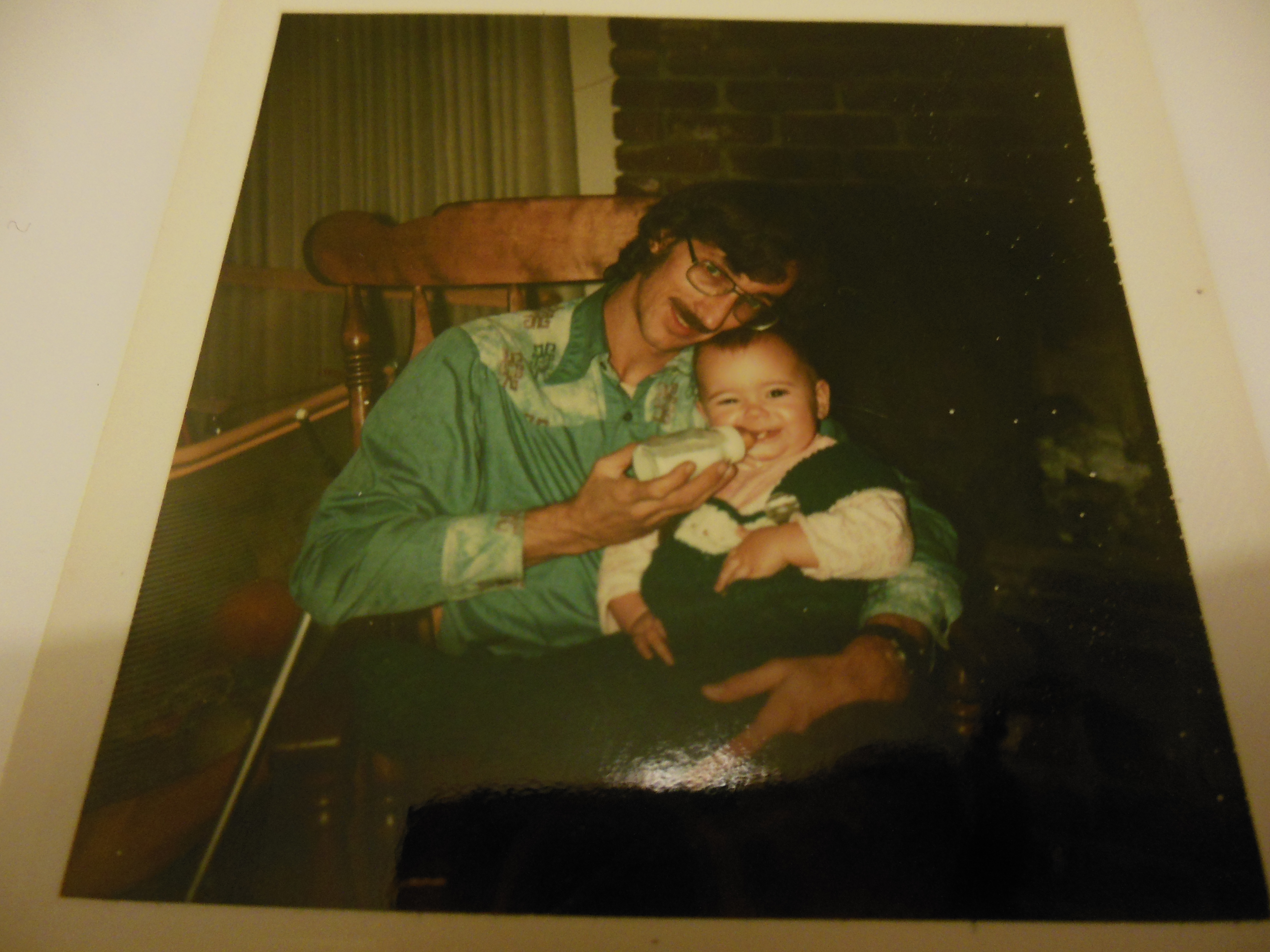
Dad holding me on my first Christmas

Dad holding me on my first Christmas


Leave a comment

Christmas Kenosis

For many good and right reasons one hears a lot in the annual lead-up to December 25 about “the true meaning of Christmas.” “Christmas is about giving and not receiving.” “Christmas is about putting aside differences and appreciating our families.” “Christmas is about remembering those who are less fortunate.” “Christmas is about love, and joy, and togetherness.” And so on.

All of these sentiments are good, and important, and worthy of reflection and application not only at Christmas time but throughout the year. It is a wonderful thing that this season encourages all of us to collectively focus attention on socially-equalizing and peace-loving values, and to do so in affirmative ways that are too often missing from our communal dialogue. I must take issue with all of them, however, as characterizations of the “true meaning of Christmas.”

The word Christmas is the slightly abbreviated combination of two words: Christ and mass. Christ, obviously, is one of the most universally recognized names for the second person of the Christian trinity, also known as Jesus. Mass, although now primarily associated with the Roman Catholic church, can in this usage be understood more generally as a term for the full Christian service of worship. If, then, what we are truly wanting to understand is Christ-mass, the sacred celebration of the person of God who came into the world, then the true meaning of Christmas must be an encounter with the incarnation.

While not the most traditional Christmas text, the most beautiful description of the incarnation, in my humble opinion, comes from the New Testament letter to the Philippians (chapter 2, verses 3 through 8).

Do nothing from selfish ambition or conceit, but in humility regard others as better than yourselves. Let each of you look not to your own interests, but to the interests of others. Let the same mind be in you that was in Christ Jesus,

who, though he was in the form of God, did not regard equality with God as something to be exploited,

but emptied himself, taking the form of a slave, being born in human likeness.

And being found in human form, he humbled himself and became obedient to the point of death–even death on a cross.

This is the real meaning of Christmas. That God — who exists so far outside the human condition that to take on the form and likeness of humanity was to voluntarily enter into slavery — did just that. And, that once this humiliation was embraced it was further eclipsed by the denigration of a criminal execution. This biblical poem uses the term kenosis in the original language, which means emptying. Christ “emptied himself” on the very first Christmas night.

Now, emptiness is not a term that we often apply to Christmas. Christmas is much more associated with fullness. Full stomachs as we gorge on feasts that take hours of loving labor and mountains of ingredients to prepare. Full eyes and ears as our senses are washed over by tidal waves of sparkling lights, colorful decorations, radio jingles, and Christmas carols. Full schedules as we struggle to find the time to address Christmas cards, complete shopping and wrapping, and participate in all the extra social activities of the season. Full spaces as we wonder how to find places for all the new clothes, toys, and other gifts that add to our accumulation of possessions. Full hearts as we look at the glowing faces of our children, or are transported into nostalgic memories of our own childhoods, or simply appreciate the precious moments to be with those we love.

The Christmas season fills us up in so many ways, and many of those ways are wonderful. This is not an harangue against the blessed fullness that we, as modern, Western, 21st Century people receive from the celebration of Christmas. What I hope it is, is a reminder that fullness is not the meaning of Christmas. Appreciation of all the gifts in our lives – those under the tree, and those we see more clearly in the late days of December – is important. It is something I am trying to teach my children about Christmas. When I recently asked Princess Imagination why we give gifts on Christmas she answered beautifully that it is to remind us that Jesus is God’s gift to us. That’s true.

But we need to also remember that this gift was and is kenosis, self-emptying. In that birth in a stable, Jesus released the honor, and authority, and perfection, and privilege, and power that is imbued in being God. There could not be a more complete or dramatic gift, and this selflessness is the real meaning of Christmas.

I had gotten so far in composing this post two days ago. Then it was time to get myself and the kiddos ready for Christmas Eve service. In the course of that activity my trick back decided that the action of bending at the waist to pick-up the Gigglemonster’s shoes was a sin punishable by severe pain of the shooting-down-my-legs-and-up-my-spine-and-continuing-for-hours-at-a-time variety. That would have been bad enough, but it was compounded by the fact that the Gigglemonster was so wound up in anticipation of the first Christmas where he could understand the upcoming barrage of presents that he only napped for about 40 minutes (as opposed to his usual 2 hours). As a result, the monster side of his personality was definitely dominant heading into the 4:30 service at my in-laws’ church. When he decided that it had to be Mommy who held him every time the congregation stood to sing a carol (I lost track at 5, but it may have been more times than that), and when my back declared that holding a 37 lb. boy while standing was a physical impossibility, things got ugly! I spent the majority of the service trying to shush him, and bribe him, and otherwise prevent a screaming tantrum, and the remainder taking him out to go to the bathroom and them experiencing the full force of the tantrum in the ladies room when I suggested that he did not actually have to strip naked to go pee.

Needless to say, Christmas Eve service was not a terribly worshipful experience for me this year. Nor was it an easy context in which I could put into practice my preceding reflections about self-emptying. I am unfortunately NOT one of those people who stoically copes with pain. Quite to the contrary, pain brings out every selfish and petulant inclination in my personality. My children’s whining, coincidentally, does the same. And so, fresh from my soulful contemplation of Christ’s self-emptying, I was confronted by the broken reality of just how full of myself I am. Full of my needs; full of my expectations; full of my own plans for how things should go. While I cannot even comprehend the power and perfection that Jesus voluntarily released, I am forced to confess that I grasp for such things. I try with all my effort to achieve them, and when circumstances, or back pain, or tired children interfere with these efforts I get annoyed or worse.

And so, I have these contrasting reflections to offer you all on what is now the day after Christmas. On the one hand, the Christmas example of self-emptying, on the other hand the fullness-seeking inclinations of my own heart. The contrast is all the more poignant to me because Jesus’ action of self-emptying subjected him to just the kinds of negative stimuli that make self-emptying so difficult to me. The kenosis meant taking on a body that was subject to physical pain, just like mine. The kenosis meant being in relationship with other people who would consider their own needs first, if not exclusively. The kenosis meant encountering personally and directly all of the things that I use as excuses for why I cannot really follow Christ’s example.

And that’s why I have to take seriously the call to have the same mind in myself that is in Christ Jesus. It’s not that Jesus just doesn’t understand or isn’t subject to the stresses I face. Jesus volunteered to face those stresses – that’s the whole point of Christmas. And so, in the 364 days until the next Christmas, I want to keep trying to empty myself. I know that in the moments I do, I will be more full than I am at any other time. For, I will be full of Christ and full of the true meaning of Christmas.