 Yesterday the kiddos and I spent the afternoon at the local park with Gra’ma and my older sister. Considering that this is our first week back in the States after our move from Milan, the title of this post might suggest that this entry will be a reflection on the differences between US and Italian playgrounds. Although such differences certainly exist, that is not the comparison that struck me during our afternoon. Rather, it was the theme of comparison itself that presented itself to my still-slightly-jetlagged brain as I interacted with and observed my children at play.
Actually, comparing is something I just started doing without any conscious thought at all. You see, there was this middle-aged man – I assumed he was a dad – who was coaching a boy of perhaps 7 or 8 years of age through various playground obstacles and activities. I use the term “coaching” advisedly, because he was setting tasks and providing guidance in an incredibly focused and intentional manner. The first comparison that sprung to mind was an insecure parenting reflex: Wow, that dad is REALLY engaged with his son. He’s giving the boy ALL of his attention. I’m just standing here watching the kids and chatting with my sister. I’m such a lazy parent! Maybe Italian playground disengagement has rubbed off on me?! (OK – there’s a little bit of Italy playground comparisons in here).
My shame-clouded eyes couldn’t turn away from the incredible spectacle of parental involvement. The intensity of the interaction was astounding. And then, as I stared, that intensity became more alarming than awe-inspiring. “Come on! Focus! Don’t look around. Listen to me. There’s the goal, OK. Jump over that. Oh, no. That was too easy. Here, I’ll move it farther out. Now jump!” Yikes, Fellow. Don’t you think that’s a bit much?! He’s just a kid who wants to play. Play is supposed to be fun, not boot camp!
My momentary spasm of self-doubt eased off to be replaced by a self-congratulating condemnation of this other parent’s model. Good parenting doesn’t mean that I have to be in my kids’ faces every moment at the playground telling them what to do. Just because I’m letting them entertain themselves in a self-directed way doesn’t mean I’m ignoring them. It actually means I’m giving them room to explore and to discover their own capacity. Why, just look at the Gigglemonster! He’s made a new friend and they are creating new games together on the spot. That’s awesome.
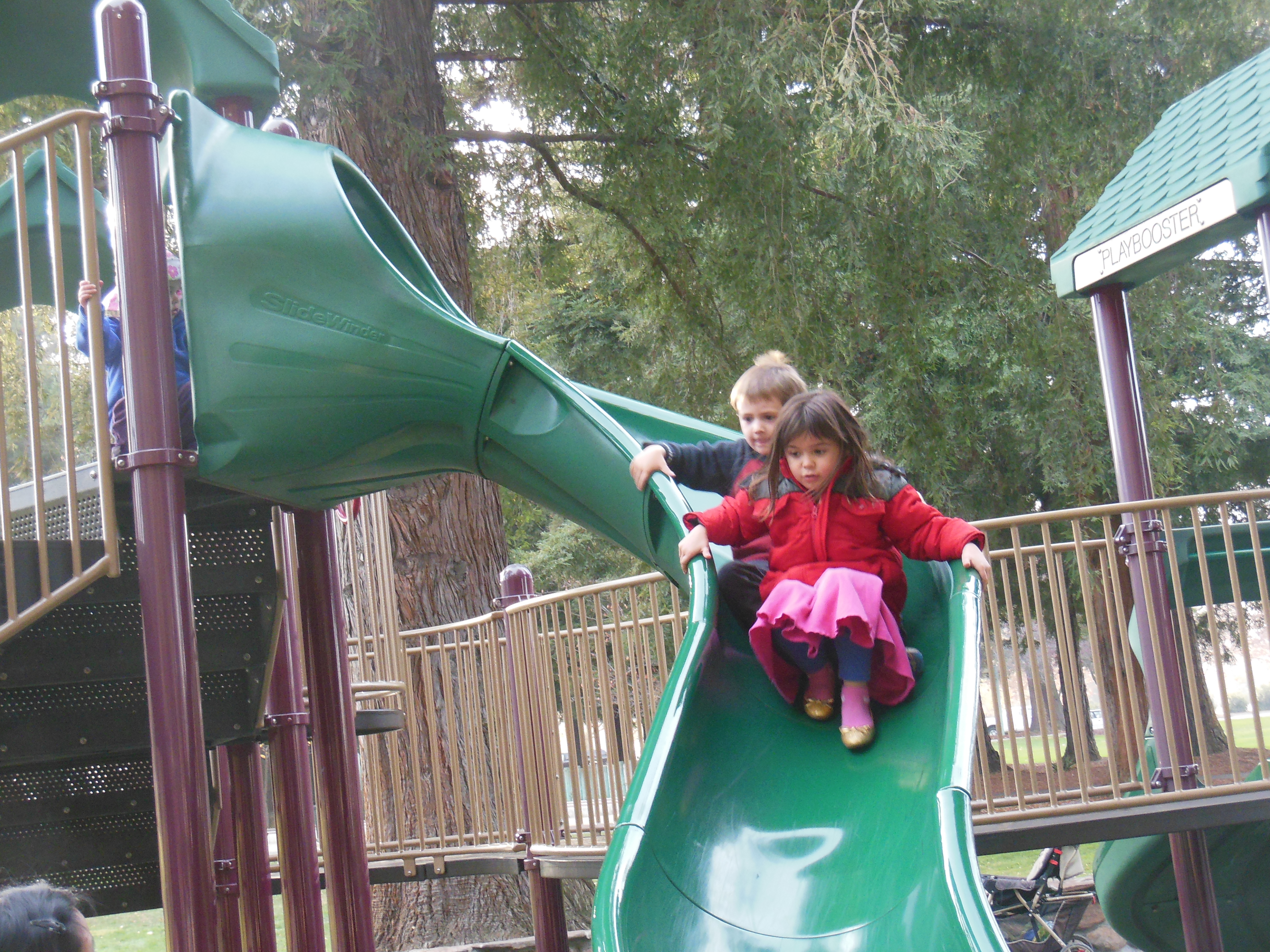
Perhaps it was some lingering misplaced need to assert my success as a parent, or perhaps it as just a natural motherly instinct to rejoice in my child’s social skill, but I pointed out the happy twosome to my sister. “He’s amazing isn’t he? Everywhere we go, he just makes friends!”

The Gigglemonster and his new buddy.
It was a harmless enough comment in most contexts, but in that particular moment it was a rookie parenting move. That is because Princess Imagination happened to be about 5 feet away, well within ear shot. I hadn’t meant it as a comparison, just a celebration of my youngest child’s friendliness, but for a big sister who is often painfully shy, it triggered an episode of reclusive self-doubt. A few minutes later I noticed the backlash of my little boast. Princess Imagination had retreated from the play structure and was standing disconsolately near me, alternately staring at her feet and glancing longingly at her brother playing with his new playmate. Oops!
OK. Maybe I’d been a bit too quick to congratulate myself for my parenting skills, but I could fix this.
“Honey, are you feeling sad about something?”
(mute nod)
“Is it because your brother is playing with that little girl, instead of you?”
(another nod, this time with a sniffle)
“I’m sure they would be happy for you to play with them.”
(head tucked in with a quick negative shake. This wasn’t going so well). My sister tactfully removed herself to supervise the oblivious youngsters and I kept trying. I offered advise about what to say to gain entry to the little play group. I regaled her with stories of my own shyness in childhood and the lessons that have helped me overcome it. I called the Gigglemonster over and extracted his invitation for Princess Imagination to join in the game. I talked for at least 10 minutes, but I don’t think I elicited more than 10 words from her in response. Eventually her painful silence defeated me and I just sat with her on the soft, blue rubber ground cover and ached. The pain of watching your child struggle with the same incapacitating shyness that stained your own childhood with lonely shadows is incredibly disempowering. I wanted desperately to make it all better, but all my ideas had met with that sad, stubborn silence.
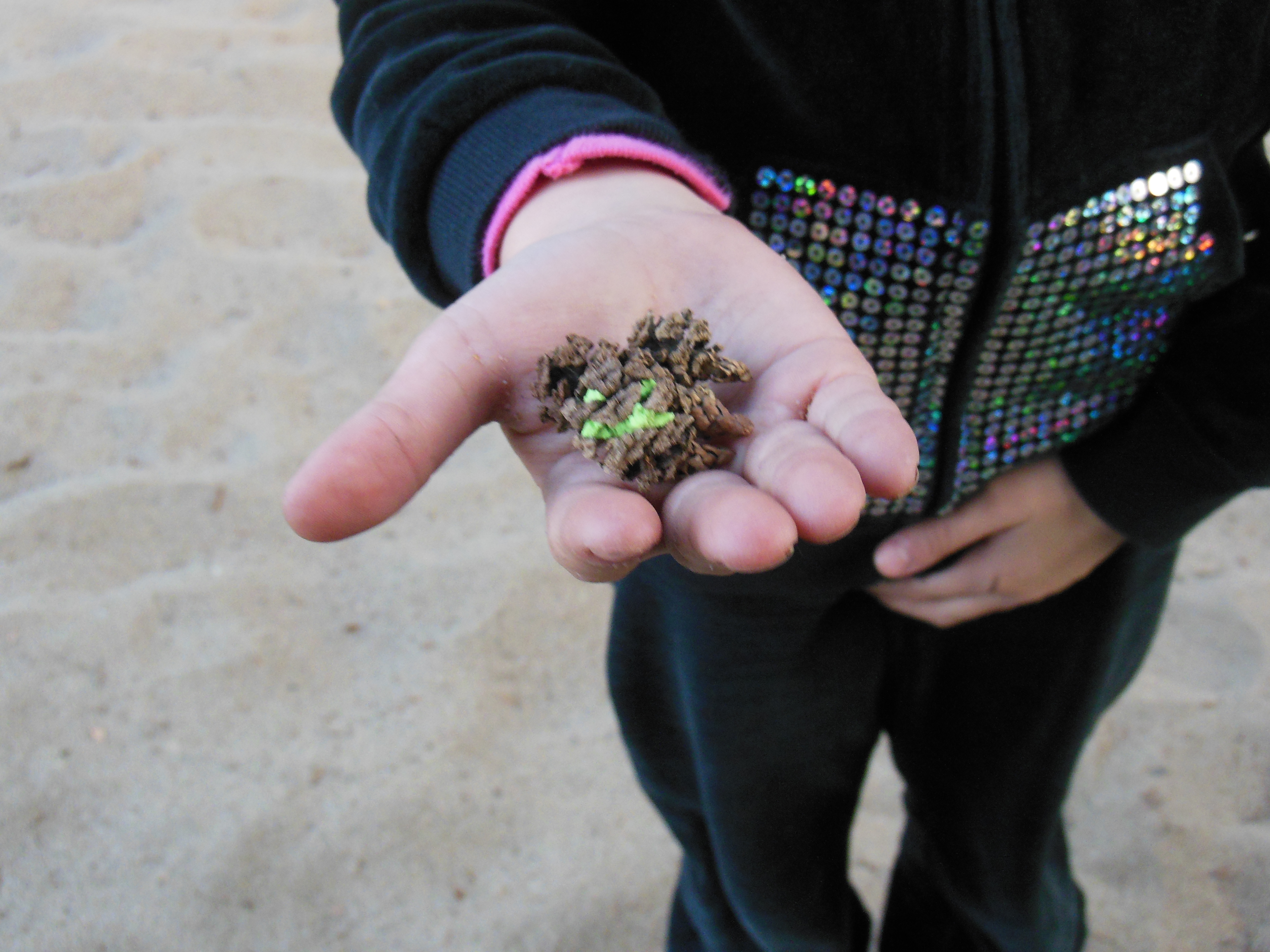
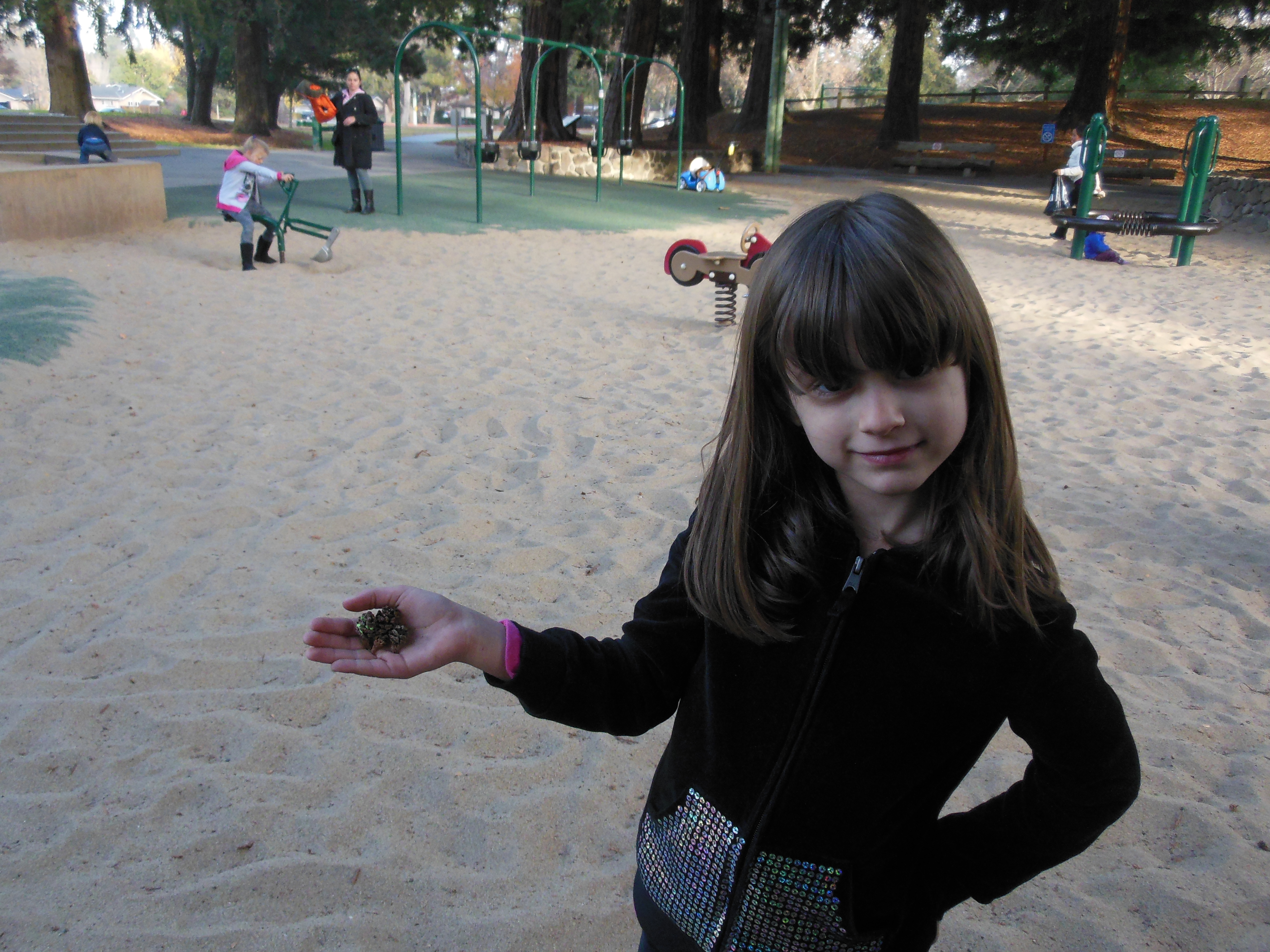
Thankfully, that silence was my daughter’s own powerful way of communicating to me, once I stopped talking and just let the silence be. In the silence I began to watch her – watch how she was coping with the situation on her own terms, rather than in comparison to her brother – and what I saw was beautiful. In her silence and isolation she had observed the few square feet of her immediate surroundings and found inspiration for a work of art. A discarded fragment of bright green foam (perhaps from a nerf ball or similar toy) could be easily torn by her nimble little fingers. A miniature pine cone was circled by small cavities just begging to be filled. Within a few short minutes she had constructed a little found-object masterpiece of contrasting colors and textures.
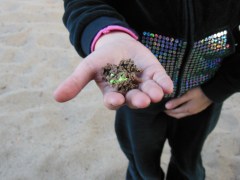
Princess Imagination’s playground art work
It was beautiful and I told her so. I also finally told her the one thing that could actually help her when she was feeling shy, and excluded, and sad: I told her why she was so special. I didn’t compare her to her social little brother. I didn’t try to give her tips to master the skills that come so easily to him. I told her that she was amazingly good at observing the world, and seeing the things that no one else notices and then seeing how to make their beauty visible to others. She’s been like that since she was a baby and it is an amazing skill that makes it so very fun to spend time with her.
I watched her smile return as she proudly displayed her artwork to Gra’ma. Then, with new confidence, she joined the game of the Gigglemonster and his new friend.

Playing together
With the crisis resolved I began to reflect on the problem of comparisons. Namely, they almost unavoidably carry value judgments along for the ride. I couldn’t just observe the dad/coach approach as different than my own and let that be, I felt the need to evaluate myself in comparison. Was I being too passive? Was he being too aggressive? The truth is, I have no idea at all about the motives and history controlling that interaction. Maybe there was a hidden disability that lay behind the routine they were practicing. Maybe he wasn’t the boy’s father at all, but rather an actual coach working with him on a set of skills. I don’t know and I don’t need to because it doesn’t concern me. There are as many different parenting techniques as there are parents, and making comparison for the sake for assigning superiority doesn’t usually teach me much of anything. It only feeds my insecurities or my pride – neither of which need any extra indulgence.
The same applies to my children. Comparisons don’t usually offer any useful life lesson, but the value judgments behind them spur the same shame/pride cycle in them. I know I can’t protect my children from feeling any insecurity. I also can’t (and don’t want to) interfere with their development of appropriate pride in their unique abilities and personalities. BUT, it is clear that this goal is best met by emphasizing what is unique and special about each of them, and they way that they can benefit those around them by using those gifts. How they compare to others should not be the foundation for self-understanding. It is much more important that I reflect for them all the positives I see in each child on her and his own terms, without judgment of others.
With that little lesson in mind I was again feeling satisfied. After all, parenting is nothing if not an exercise in trial and error. The important thing was to learn from the errors. Well, I had learned my lesson and the kids were playing happily so all was well…..
Of course, such a moralistic ending wouldn’t be real life. The happy play lasted maybe 10 minutes before I had a crying Princess on my hands again. The game had hit a snag and she was feeling excluded again. The little playmate was called away to go home then, and the Gigglemonster ran off to play with his Auntie, but Princess Imagination’s tears wouldn’t stop. There was clearly more going on here that a disagreement about which Princess she got to be in a game that was now over. After a little judicious use of silence (I had learned something from our earlier conversation), the heart of the pain came out between sobs.
“Mommy, I don’t have any friends now!”
What could I say to that deep fear and pain? I could tell her the truth that I knew she would make new friends once we settle into our house and her new school. I could remind her that she is an amazing girl, and that’s why her friends back in Italy had wanted to be her friends, something that new kids would discover too. I could briefly rehearse for her the reasons that I trust God is directing our steps, based on 36 years of personal experience. I could and did say all these things, and they helped… a little bit.
The truth is, making friends is hard for her. It just is. It wouldn’t matter if I had never uttered the word “shy” around her or never once commented in her hearing about how easily her brother makes friends. As I had told her earlier – she is an observer. It doesn’t require my thoughtless evaluations for her to recognize that she and her brother interact differently with new children, and that she usually makes friends slowly. I probably haven’t been as careful as I should to model non-judgment and non-comparison, but I can’t eliminate that from her environment entirely. And with her seeing eyes and her analytical brain she can draw her own conclusions with no help from me.
So, where does that leave my sweet, sensitive, socially insecure daughter? And where does that leave me as her mother who desperately wants to protect her from pain? The fact is that we are moving back to a home she hasn’t visited since she was 3 1/2 years old, and there are only a few friends she even remembers. She will need to make new friends, and that has not always been so easy for her. Comparisons are irrelevant. It is the difficulty itself that has to be dealt with.
So, what can I do to help her? I can encourage her with reminders of all the friendships she has made in the past. I can build her up by noticing the wonderful, unique, amazing characteristics that are evident to anyone who really pays attention. I can expect great things from her, and from the God who is guiding our steps.
And when the inevitable comparisons come, I can remind her (and myself) not to get hung up on the judgments. She is not better or worse than her brother (or any other child) because of the way she makes friends. She makes friends that way because of who she is, and that “who” is a truly amazing person.

I wouldn’t change her for the world!


 Faith, Family, & Focaccia