

Faith, Family, & Focaccia

A faith and culture Mommy blog, because real life gets all mixed together like that.


3 Comments

Playground Comparisons

304Yesterday the kiddos and I spent the afternoon at the local park with Gra’ma and my older sister.  Considering that this is our first week back in the States after our move from Milan, the title of this post might suggest that this entry will be a reflection on the differences between US and Italian playgrounds. Although such differences certainly exist, that is not the comparison that struck me during our afternoon. Rather, it was the theme of comparison itself that presented itself to my still-slightly-jetlagged brain as I interacted with and observed my children at play.

Actually, comparing is something I just started doing without any conscious thought at all. You see, there was this middle-aged man – I assumed he was a dad – who was coaching a boy of perhaps 7 or 8 years of age through various playground obstacles and activities. I use the term “coaching” advisedly, because he was setting tasks and providing guidance in an incredibly focused and intentional manner. The first comparison that sprung to mind was an insecure parenting reflex: Wow, that dad is REALLY engaged with his son. He’s giving the boy ALL of his attention. I’m just standing here watching the kids and chatting with my sister. I’m such a lazy parent! Maybe Italian playground disengagement has rubbed off on me?! (OK – there’s a little bit of Italy playground comparisons in here).

My shame-clouded eyes couldn’t turn away from the incredible spectacle of parental involvement. The intensity of the interaction was astounding. And then, as I stared, that intensity became more alarming than awe-inspiring. “Come on! Focus! Don’t look around. Listen to me. There’s the goal, OK. Jump over that. Oh, no. That was too easy. Here, I’ll move it farther out. Now jump!” Yikes, Fellow. Don’t you think that’s a bit much?!  He’s just a kid who wants to play. Play is supposed to be fun, not boot camp!

My momentary spasm of self-doubt eased off to be replaced by a self-congratulating condemnation of this other parent’s model. Good parenting doesn’t mean that I have to be in my kids’ faces every moment at the playground telling them what to do. Just because I’m letting them entertain themselves in a self-directed way doesn’t mean I’m ignoring them. It actually means I’m giving them room to explore and to discover their own capacity. Why, just look at the Gigglemonster! He’s made a new friend and they are creating new games together on the spot. That’s awesome.

Perhaps it was some lingering misplaced need to assert my success as a parent, or perhaps it as just a natural motherly instinct to rejoice in my child’s social skill, but I pointed out the happy twosome to my sister. “He’s amazing isn’t he? Everywhere we go, he just makes friends!”
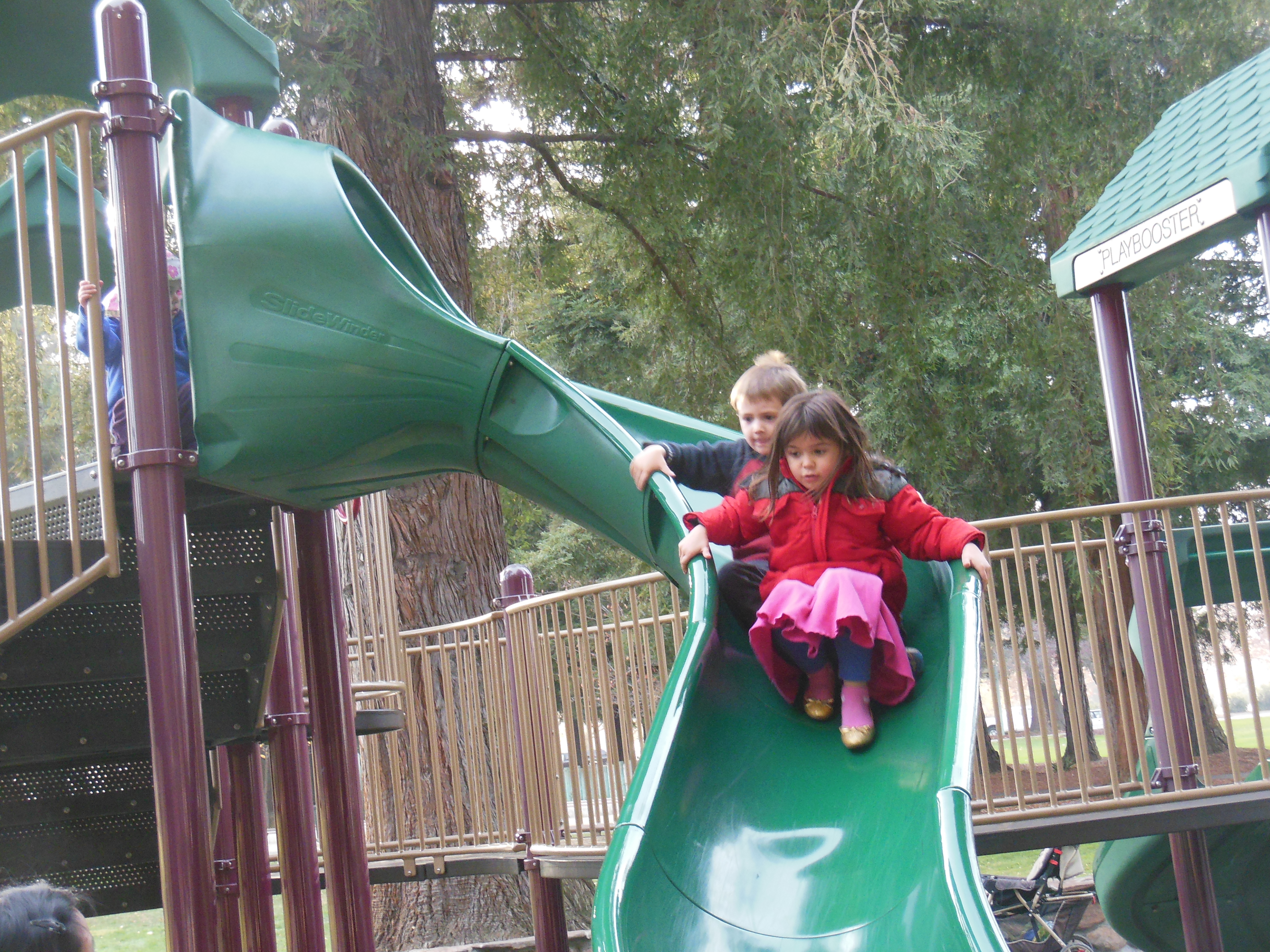
The Gigglemonster and his new buddy.

The Gigglemonster and his new buddy.

It was a harmless enough comment in most contexts, but in that particular moment it was a rookie parenting move. That is because Princess Imagination happened to be about 5 feet away, well within ear shot. I hadn’t meant it as a comparison, just a celebration of my youngest child’s friendliness, but for a big sister who is often painfully shy, it triggered an episode of reclusive self-doubt. A few minutes later I noticed the backlash of my little boast. Princess Imagination had retreated from the play structure and was standing disconsolately near me, alternately staring at her feet and glancing longingly at her brother playing with his new playmate. Oops!

OK. Maybe I’d been a bit too quick to congratulate myself for my parenting skills, but I could fix this.

Honey, are you feeling sad about something?”

(mute nod)

“Is it because your brother is playing with that little girl, instead of you?”

(another nod, this time with a sniffle)

“I’m sure they would be happy for you to play with them.”

(head tucked in with a quick negative shake. This wasn’t going so well). My sister tactfully removed herself to supervise the oblivious youngsters and I kept trying. I offered advise about what to say to gain entry to the little play group. I regaled her with stories of my own shyness in childhood and the lessons that have helped me overcome it. I called the Gigglemonster over and extracted his invitation for Princess Imagination to join in the game. I talked for at least 10 minutes, but I don’t think I elicited more than 10 words from her in response. Eventually her painful silence defeated me and I just sat with her on the soft, blue rubber ground cover and ached. The pain of watching your child struggle with the same incapacitating shyness that stained your own childhood with lonely shadows is incredibly disempowering. I wanted desperately to make it all better, but all my ideas had met with that sad, stubborn silence.

Thankfully, that silence was my daughter’s own powerful way of communicating to me, once I stopped talking and just let the silence be. In the silence I began to watch her – watch how she was coping with the situation on her own terms, rather than in comparison to her brother – and what I saw was beautiful. In her silence and isolation she had observed the few square feet of her immediate surroundings and found inspiration for a work of art.  A discarded fragment of bright green foam (perhaps from a nerf ball or similar toy) could be easily torn by her nimble little fingers. A miniature pine cone was circled by small cavities just begging to be filled. Within a few short minutes she had constructed a little found-object masterpiece of contrasting colors and textures.

Princess Imaginations playground art work

Princess Imagination’s playground art work

It was beautiful and I told her so. I also finally told her the one thing that could actually help her when she was feeling shy, and excluded, and sad: I told her why she was so special. I didn’t compare her to her social little brother. I didn’t try to give her tips to master the skills that come so easily to him. I told her that she was amazingly good at observing the world, and seeing the things that no one else notices and then seeing how to make their beauty visible to others. She’s been like that since she was a baby and it is an amazing skill that makes it so very fun to spend time with her.

I watched her smile return as she proudly displayed her artwork to Gra’ma. Then, with new confidence, she joined the game of the Gigglemonster and his new friend.

Playing together

Playing together

With the crisis resolved I began to reflect on the problem of comparisons. Namely, they almost unavoidably carry value judgments along for the ride. I couldn’t just observe the dad/coach approach as different than my own and let that be, I felt the need to evaluate myself in comparison. Was I being too passive? Was he being too aggressive? The truth is, I have no idea at all about the motives and history controlling that interaction. Maybe there was a hidden disability that lay behind the routine they were practicing. Maybe he wasn’t the boy’s father at all, but rather an actual coach working with him on a set of skills. I don’t know and I don’t need to because it doesn’t concern me. There are as many different parenting techniques as there are parents, and making comparison for the sake for assigning superiority doesn’t usually teach me much of anything. It only feeds my insecurities or my pride – neither of which need any extra indulgence.

The same applies to my children. Comparisons don’t usually offer any useful life lesson, but the value judgments behind them spur the same shame/pride cycle in them. I know I can’t protect my children from feeling any insecurity. I also can’t (and don’t want to) interfere with their development of appropriate pride in their unique abilities and personalities. BUT, it is clear that this goal is best met by emphasizing what is unique and special about each of them, and they way that they can benefit those around them by using those gifts. How they compare to others should not be the foundation for self-understanding. It is much more important that I reflect for them all the positives I see in each child on her and his own terms, without judgment of others.

With that little lesson in mind I was again feeling satisfied. After all, parenting is nothing if not an exercise in trial and error. The important thing was to learn from the errors. Well, I had learned my lesson and the kids were playing happily so all was well…..

Of course, such a moralistic ending wouldn’t be real life. The happy play lasted maybe 10 minutes before I had a crying Princess on my hands again. The game had hit a snag and she was feeling excluded again. The little playmate was called away to go home then, and the Gigglemonster ran off to play with his Auntie, but Princess Imagination’s tears wouldn’t stop. There was clearly more going on here that a disagreement about which Princess she got to be in a game that was now over. After a little judicious use of silence (I had learned something from our earlier conversation), the heart of the pain came out between sobs.

Mommy, I don’t have any friends now!”

What could I say to that deep fear and pain? I could tell her the truth that I knew she would make new friends once we settle into our house and her new school. I could remind her that she is an amazing girl, and that’s why her friends back in Italy had wanted to be her friends, something that new kids would discover too. I could briefly rehearse for her the reasons that I trust God is directing our steps, based on 36 years of personal experience. I could and did say all these things, and they helped… a little bit.

The truth is, making friends is hard for her. It just is. It wouldn’t matter if I had never uttered the word “shy” around her or never once commented in her hearing about how easily her brother makes friends. As I had told her earlier – she is an observer. It doesn’t require my thoughtless evaluations for her to recognize that she and her brother interact differently with new children, and that she usually makes friends slowly. I probably haven’t been as careful as I should to model non-judgment and non-comparison, but I can’t eliminate that from her environment entirely. And with her seeing eyes and her analytical brain she can draw her own conclusions with no help from me.

So, where does that leave my sweet, sensitive, socially insecure daughter? And where does that leave me as her mother who desperately wants to protect her from pain? The fact is that we are moving back to a home she hasn’t visited since she was 3 1/2 years old, and there are only a few friends she even remembers. She will need to make new friends, and that has not always been so easy for her. Comparisons are irrelevant. It is the difficulty itself that has to be dealt with.

So, what can I do to help her? I can encourage her with reminders of all the friendships she has made in the past. I can build her up by noticing the wonderful, unique, amazing characteristics that are evident to anyone who really pays attention. I can expect great things from her, and from the God who is guiding our steps.

And when the inevitable comparisons come, I can remind her (and myself) not to get hung up on the judgments. She is not better or worse than her brother (or any other child) because of the way she makes friends. She makes friends that way because of who she is, and that “who” is a truly amazing person.

I wouldn't change her for the world!

I wouldn’t change her for the world!


5 Comments

Are My Children Too Young to Worship?

St. Paul's Cathedral, London

St. Paul’s Cathedral, London

My children are young.

They are not so young that I assume every night will involve at least one cry for sustenance that is only available from my body. They are not so young that my wardrobe decisions are ruled by the preemptive value of washable fabrics that will camouflage shoulder spit-up stains. They are not so young that I am forced to carry a diaper bag, as opposed to getting by with a large purse that can accommodate a package of wipes, diverse toys and snacks, and at least one sippy cup. They are not even so young that the high-pitched announcement “I need to go potty” must immediately be followed by a mad dash to the nearest toilet with a grimacing child held out in front of me in the hope of avoiding any accidental leakage onto my clothes.For the most part, I can happily proclaim that those days are behind me. The Gigglemonster just marked the completion of his fourth year outside my womb which probably means that I am really and truly past the tiny tots stage.

Nevertheless, and despite my weepy birthday moments of exclaiming over how fast they are growing up, my children are still very young. And, what it more, I am discovering that my children’s passage though the indeterminate border region that divides “he/she’s too young to know better” from “she/he is old enough to understand that different rules of behavior apply to different situations” makes for some really challenging parenting moments. What is more, the younger one’s maturation process into a genuine playmate has somehow transformed the older one into a partner worthy of his happy-tornado personality. The sweet, shy, quiet little girl who has previously generated parenting angst only in concern about helping her engage more socially is rapidly morphing into an explosive ball of irrepressible energy who can’t seem to understand why I don’t appreciate her use of her own head as a battering ram to forcibly connect to the more sensitive parts of my anatomy, and who is suddenly resistant to my pleas to be a good example for her little brother in calming down when the situation calls for a bit more reserve. I love both my children to distraction, and no day could be perfect if they were not a major part of it, but Good Grief! I am desperate for someone in our family to identify some mechanism to moderate the wild, destructive energy that is pulsing through our lives and seems ready to pounce at me from around the corner of every parenting decision.

One such particularly mauling pounce occurred last week toward the end of our family’s 5-day whirlwind tour of London. To be fair to the kiddos, we asked a lot of them and didn’t trouble ourselves to request their input too much in the itinerary planning. To be fair to me, I did cut out all possible museum visits and tried to weight each day’s activities with child-friendly options. The Gigglemonster got to attend both a Manchester United match and an American football game (at both of which his team dominated, Go 9ers!). Princess Imagination got to decree that our visit to the Tower of London focused on the historical reenactment of famous female prisoners at the tower, which she found utterly fascinating. The only moments spent in the purse sections of Harrods were those we spent walking through in order to get to the chocolate room and the Christmas shop, and we ate lunch upstairs at the Disney Café. All in all the trip was really designed to please young children as much as possible, especially considering that this was not their first cultural tourist trek and they have given me good cause to expect that they will behave themselves well as long as they get regular snacks and don’t have to walk too much.

Cheering for the 9ers! (with his first foam finger)

Cheering for the 49ers! (with his first foam finger)

The Disney Café had a life-sized Rapunzel!

The Disney Café had a life-sized Rapunzel!

Unfortunately, the font of squirmy energy that has recently begun receiving fresh underground supplies from an unknown source chose a particularly inauspicious moment in our tour to erupt. That moment was Evensong at Westminster Cathedral.

My wonderful mother-in-law (Nanna as the kids call her) was along for the trip and stayed with me and the kids after Tyler had to return to work in Milan. She had never seen the famous and beautiful cathedral and we had decided together that a lovely way to experience Westminster would be the nightly Evensong service. The timing was theoretically perfect. The service was at 5:00, so we could give the  children a little snack beforehand and they wouldn’t be frantic for dinner until well after the service concluded around 6:00. The participation in the service was open to all interested people (no age limit was expressed in any of the descriptions), and it would offer the chance for our experience in the historic church to have more spiritual depth, rather than feeling like another tourism moment. Princess Imagination had participated two days earlier in a communion service at St. Paul’s (while the Gigglemonster was in Manchester with Daddy), and while the service wasn’t without incident it had been the highlight of the trip so far for both Nanna and I. We were both really looking forward to the hour of music and prayer.

If I had known how disastrous it was going to be, I would have found a nearby place to park with the kids while Joan went alone.

Just before we went into Westminster Cathedral. They look so sweet and well-behaved...

Just before we went into Westminster Cathedral. They look so sweet and well-behaved…

It all started well. We entered quietly and the kids stopped to light a candle and say a prayer (the part of Cathedral visits they always find most exciting). They needed a couple of reminders to keep their voices low, but they weren’t unusually energetic. As we approached the congregational seating area a priest ushered us to an aisle where he promptly removed a chair to make space for our stroller and I remember thinking how kind and accommodating he was. Oh the irony!

As we seated ourselves the Gigglemonster squirmed out of the stroller and decreed a sitting arrangement that left me on one end next to him, while Princess Imagination was on the far side of Nanna. It wasn’t ideal, but the room was unnaturally quiet in the minutes of pre-service meditation, despite the hundred or so other worshiper, so I felt it was wisest to just sit down as quickly and quietly as possible. I leaned close to the small, pink ear of my smallest child to whisper a few calm reminders about needing to be quiet and listen in church so that we don’t disturb all the other nice people who are here to worship God too. He nodded agreement and I didn’t notice any tell-tale gleam of resistance in his sparkling brown eyes.

He lasted about 5 minutes. First he was not content that I be holding the order of worship as we rose for the first hymn. I should be holding him instead. That was fine, but he expressed his desire by ripping the card out of my hand and throwing it on the ground. Normally, that kind of unnecessary aggression would have elicited a firm redirection from me, but the shroud of absolute silence that seemed to envelope all participants in the service other than the official voices muffled my tongue. I let it be and cuddled him close, hoping that this affection would meet his needs and infuse him with some of the calm the service was supposed to impart. Ever curious, however, he next started with questions: about where the voices floating out from the quire were coming from, about what the archaic language of the service meant, about why it was dark outside, about any little thing he could think of.

In almost any other context we have worshipped in, his behavior wouldn’t have been exceptional – he was whispering softly and his wriggling body was at least confined to the two seats he and I had taken. Here, however, in the vaulted halls of Westminster, his violation of the unwritten rule of absolute silence echoed loudly. I felt my own tension rising to fill the huge, stone-arched space. I desperately tried to whisper answers with the barest breath of sound; I tried to shush him and remind him that he was distracting other worshippers; I tried to distract him with a small pen and pad of paper, but then he insisted in sprawling on the floor to do his “coloring” and I had a panicked foreshadowing of my attempts to apologize to the priests for a smeared line of blue ink across the storied marble tiles. Princess Imagination then entered the fray by shuffling down from her seat and making an effort to worm her ever-lengthening body onto my lap. That, of course, immediately precipitated a sibling squabble. I was near tears and perhaps farther away for a worshipful attitude than I had ever been in a church before that moment. I tried to shoo my daughter back to her assigned seat, but she stubbornly wriggled in resistance. The repressive atmosphere must have registered with her as well because at least she kept her voice low as she whined in my ear “but I want to sit on your lap.”

I snapped. “I want” is a phrase we have been talking about a lot in our family recently. It comes out of both our children’s mouth with a frequency that drives me up a wall, and we have discussed ad nauseam the importance of understanding that being a family is about cooperating. It is not wrong to have wants or to express them, but it is not OK to just stubbornly insist on them when your want is hurting someone else in the family. If you phrase your repeated expression of a desire for a given thing in our family with “but I want…” you are probably not going to like the result. Princess Imagination knows this very well. “I don’t care what you want,” I hissed into her ear “go back to your seat right now.” It wasn’t my finest parenting moment and I was ashamed of myself as soon as I said it, but she slunk sulkily back to her seat. In that tension-filled moment I was prepared to take an ugly win.

The Gigglemonster, of course, immediately jumped into the space his sister had vacated (as his right, given his original sitting position in the seat next to mine). It calmed him for about 30 seconds. Then he felt in my back pocket and whispered into me ear. “Can I have the iphone?” I jumped at the solution. I slid the sound function to silent and opened up the Feed Me game. Then I breathed. This was good, he settled down happily, his little face inches from the 4 1/2 inch screen, and began finger-dragging objects with intense concentration to appropriately match the shining color prompts. Miraculously, Princess Imagination joined him and they crouched soundlessly and cooperatively in front of the magical device to play together. We were half way through the service. Perhaps I would still have a chance to quiet my heart beat and still my mind to encounter the great God who had inspired such soaring beauty.

I was almost there. I had almost released all my frustration and angst and begun to rest in the meditative prayer of the service when our “accommodating” priest was suddenly bustling toward us with a reproving, even angry expression. “Please turn that off immediately.” “Please” was technically how he began the sentence, but it was not a request. I assumed he was worried about the potential for noise in the sacrosanct silence of the church. “It’s on silent…” I began in a conciliatory whisper, but he cut through my explanation. “Just turn it off now.”

OK. I immediately bent down and took the phone out of the Gigglemonster’s contented hands and turned it off with a murmured “I’m sorry, Honey, it’s the rules.” At this point in the story, I think my 4-year old deserves a round of applause. He could have grabbed for the phone with a loud objection. He could have protested querulously why his quiet, educational entertainment was being taken away. He could have thrown a full-on tantrum on the floor and disrupted the entire service. He did none of these things. He did whisper a “why?” and while I was floundering with my own responsive whisper of “I don’t know honey, the priest just said I have to turn it off” the priest provided a more complete (though to me incomprehensible) answer to Joan. Apparently the church would not tolerate toys of any kind in the service. It wasn’t just electronic devises. Children who came to the church were expected to sit for any hour like miniature adults in total silence.

Huh?

OK. I understand that Westminster Cathedral is not the casual, post-hippy environment of the evangelical church in which I grew up. I didn’t expect them to clear away the chairs at some point in the service so that we could all dance before the Lord like David did. I didn’t even expect them to invite the children forward for a children’s sermon that would have given them some context for understanding all the grown-up talk ,as other Anglican/Episcopal churches often do before the homily. This was an ancient cathedral and it was understandably a more formal environment. But “no toys of any kind”? Really? All worshippers are welcomed to attend, but preschoolers should be prepared to sit for an hour in the evening and listen to choral music, scripture readings from the King James Version, and a chant-like homily with absolutely no distractions? What boggles my mind even more is the fact that all responsible adults are apparently expected to intuitively know this rule and enforce it without intervention. According to Nanna’s recount of the reprimand, this was most certainly the attitude of our stroller-accommodating priest. It wasn’t reasonable for him to have to quietly inform us of this policy before he removed the extra chair, or for a discrete notice to be printed on the service sheet. We should have understood it independently and he was frankly scandalized by our failure to control my phone-wielding children.

Looking back on the incident it is fairly easy to recognize a lot of things I shouldn’t have done. I shouldn’t have depended on a whispered, “now, we have to be quiet during the service” as the sole preparation I gave my children as we entered the hallowed ground of the church. I shouldn’t have let my own anxiety in the situation escalate to a barely controlled tension that couldn’t help but communicate itself to my children and increase their unease. I shouldn’t have snapped angrily into my sweet daughter’s ear that “I didn’t care” about what she wanted, no matter how many times I have explained the inappropriateness of insisting on her own wants without listening to the reasons for why she can’t have them right now. I most certainly shouldn’t have spent the remainder of the service (and significant portions of the following hours and days) stewing in my anger at the rebuking priest who was just doing his job, no matter how ungraciously.

Perhaps I shouldn’t have even gone to the Evensong with my children, or at least I shouldn’t have approached the service with such cavalier expectation of a joyful encounter with God that ignored my responsibility to heavily prepare my children for a very different worship environment and to vigilantly supervise their behavior. The possibility that I just shouldn’t have gone, however, has prompted me to ponder the question that titles this entry. Are my children too young for worship? Are my children really too young to participate in the forms of Christian practice that are most purely reverential and submissive, those forms that require the most rejection of our own immediate sense of self in order to foster a shadowy awareness of God’s otherness and majesty, those forms that are in some ways most worshipful because they emphasize the distance between our natural state and God’s glory?

My own personal journey of faith took many, many steps before really appreciating this aspect of Christian worship. I grew up with a highly approachable God, the Abba/Daddy that Jesus prayed to. This was a God who loved me personally, and I could take anything to him. I didn’t have to worry about “not behaving that way in church” because God saw me all the time, and loved me in every context, and the stiff comportment required by uptight, mainline denominations was “too legalistic” and didn’t reflect our freedom in Christ. At family camp my Pastor actually wore cut-off jean shorts while preaching (gasp!).

This God is utterly biblical and much easier to explain to young children than the more distant and holy images of God that are also portrayed in the pages of the Bible (not to mention the violent and vengeful passages that, frankly, a lot of adult Christians are not emotionally and spiritually ready to acknowledge). Given the large swath of Christendom that shies away from the God Rudolf Otto describes as Wholly Other, it is hardly fair of me to expect my children’s young faith to relish the spiritual encounter with majesty in the context of grandiose silence.

And yet… One of the many wonderful blessings I have enjoyed during our European sojourn is the chance to experience spiritual growth through the medium of Europe’s grand Cathedrals. A slightly disdainful discomfort with the opulence and expense that these monuments represent has slowly been moderated by an appreciation for how they direct my mind to the transcendence and grandeur of God. Awe and reverence can frankly be hard to grasp when God is the buddy you carry around in your heart so you can pour out your troubles in any time and place that suits you with a quick “Dear Jesus” prayer. Much easier to really sink into an appreciation of just how great Christ’s choice to humble himself was, when I have to crane my neck back uncomfortably to gaze up at a broken body hanging from a cross in a context of glittering, awe-inspiring beauty. This enhanced awareness of God’s greatness and glory has truly deepened the power of my faith in my life, and I want that power for my children’s faith as well. I want to expose them not just to the casual, accessible God, but also to the God so far above us that we can never reach God on our own.

But how do I find that balance? It’s not just a curmudgeonly priest at Westminster Cathedral that I have to overcome. On our earlier visit to St. Paul’s my most docile child had struggled to comport herself in a manner that shows any understanding of the duty of reverence.

Our family on the steps of St. Paul's Cathedral, before the boys took off for the game.

Our family on the steps of St. Paul’s Cathedral, before the boys took off for the game.

The national cathedral is an equally beautiful and awe-inspiring building that offered an entirely more open experience of worship (the priest kept inviting us to sit or stand or sing with the phrase “perhaps you will…”). Nevertheless, when the time came for interested congregants to come forward for communion, she threw a mini fit. I reminded her as we processed up the line that she would receive a blessing rather than communion, since she hasn’t yet been baptized. She got upset. Perhaps she was hungry and eager for a little snack. Perhaps she didn’t want an unfamiliar old man putting his hand on her head. Whatever the reason, she was not interested, and she angrily demanded that I leave the line to go back to our seats with her. I didn’t think it was appropriate to give in to this imperious order and I calmly said no. She didn’t actually throw a tantrum, but she nearly tore my arm out of its socket as she clung to my hand and retreated behind my back with an angry glare as the priest attempted to offer her the blessing. When we talked later about how rude that had been she could grudgingly apologize for ignoring my instructions and insisting that I forgo the communion, but she expressed no sense that such behavior was irreverent in a context of worship, a sense that had made my own experience of the incident much more mortifying.

Obviously, I made a lot of parenting errors in London churches and I am painfully aware that my own embarrassment when my children act out in public is far too acute. Nevertheless, I feel like I must be missing something in the way I am teaching my children about what it means to worship in church. I lack a language and a teaching context for helping my children to encounter reverence in worship. I want my children to know God as close, and loving, and intimate, but not at the expense of any sense that God deserves our deepest respect. Obviously, it’s not all on me. God has a stake in my children’s spiritual growth as well and God’s Spirit is the only one who had ultimately call forth faith. But I still feel heavily the responsibility to teach my children well.

So, I turn to you, my readers. What do you think? Is faith a journey of discovery in which we can present just one aspect of God early on until children are ready for more? Should we teach them about being quiet and respectful in church at the risk of an association between God and repression? Should we try to expose them to different contexts for worship or just abstain from opportunities to worship with other branches of the faith “until the kids are old enough?” Are my kids just spoiled brats that can’t handle rules because I’m too soft on them? OK, that last one in tongue-in-cheek, but I really am interested in your opinions.

What guidelines would you recommend for a Christian mom trying to teach her children how to worship of a God who is both near and loving and transcendent and glorious?