Faith, Family, & Focaccia

A faith and culture Mommy blog, because real life gets all mixed together like that.


2 Comments

Hair and Vanity

Princess Imagination and I have an ongoing battle about her hair. I want it brushed regularly. She resists contact between her hair and any kind of brush or comb. I want it arranged in some way that looks relatively neat and keeps it from covering up half her face. She prefers it wild and free, which invariably means it is ends up in her mouth and eyes and makes it hard to see her pretty little face.

At the beginning of the week I thought I had finally landed on a solution: headbands. After refusing a ponytail, braids, or clips, Princess Imagination enthusiastically embraced my desperate proposal that she at least hold her hair off her face with a headband. She allowed me to settle it in place just behind her bangs, with the wispy curls she still has framing her face from her baby days securely tucked behind the band. Suddenly she looked neat and well-kept and her sweet little face was fully visible. Victory! We were both happy, and since she has a large selection of these hair-taming accessories, I had a lovely fantasy of future mornings unmarred by mother-daughter hair battles.

The fantasy lasted until I picked her up from school that afternoon. In the intervening hours her sparkly pink headband had somehow been transformed from a hair-taming implement into a co-conspirator in operation birds nest. Rather than neatly holding back her hair from its proper position atop her head, it had gone vertical and was smashing her bangs flat on her forehead while the escaped front locks were running free, with several section plastered across her cheeks as the result of time spent bathing in her mouth. Argh! What is wrong with my child?! She is a beautiful little girl, but no one can see that because she seems determined to turn her hair into a frizzy, knotted, veil!

With the distance of a few days I can recognize that my response to this very unusual styling was probably an over-reaction. I don’t think Princess Imagination is deliberately covering her face with her hair. She simply finds it uncomfortable to have her hair pulled back, and also finds it convenient to suck on her hair to satisfy her oral fixation (which is probably my fault for nursing her so long). The resulting follicle foibles do not worry her because she is just oblivious to what she looks like.

And there’s the source of discomfort in this little domestic squabble. The problem is that appearance is not a matter of oblivion for me. In contrast to my daughter’s indifference, I care a little too much about appearance – both hers and mine. This concern about how I and those associated with me look goes back a long way. I can vividly remember my own screaming temper tantrum at the age of 8 or 9 in reaction to a rather unusual wardrobe selection by my older sister. Granted, choosing to wear a wrap-around ballet skirt as a shawl was eccentric on the part of my sister, but my reaction was also a bit excessive. And the extremity of my reactions, from the mid-80s to now, makes it clear that the issue  is really with me, not with the creative accessorizers in my family. I just care too much about appearance.

Now, this is not to say that I am a fashion plate by any stretch of the imagination. I do not have dozens of handbags. I do not buy shoes to match specific outfits. I cannot justify spending three or four times as much for designer labels. And I do not spend an hour coiffing my hair every morning (or any time of day, ever). BUT… I have to admit, that there is a very dissatisfied little corner of my mind that turns an unattractive shade of green when it spies the glamourously styled moms doing drop-off at school. I am ashamed of it, but it is there. A part of me desperately wants to be the one who draws admiring, or even envious looks.

Of course, more than a year and a half of residence in one of the capitals of the fashion world has exacerbated this tendency. Two years ago I could not have even attempted to tell you what the fashion trends of the season were. I bought clothes that suited my style and figure and did not worry too much about what was trendy. Now, just taking my kids to school or walking past the shop windows in the neighborhood of my Italian class gives me an education in the current colors, cuts, and must-have accessories. This knowledge is anything but helpful. It focuses my awareness on all the things I don’t have and makes me self-conscious about the functional clothes and shoes dictated by my role as a stay-at-home mom. In more basic terms, it both increases the value I place on appearance, and amplifies my dissatisfaction with my own achievement relative to that standard.

Naturally, this evolution has not made for a happier me. However, I realized something as a result of my headband confrontation with Princess Imagination. My feelings of fashion-inadequacy are not really the matter of greatest importance. What matters is how much I have allowed my appearance, and my daughter’s, to impact my emotional state. I do not want to be that mother. I do not want to be that woman.

What I do want is to teach my daughter that what matters is the kind of person we are, not the way we look. What I do want is to teach her is to be concerned about what her behavior and her speech (rather than her clothes and her hair) tell other people about who she is. What I do want is to live the kind of life that teaches these lessons more effectively than my words ever could. These desires are not easy to achieve. It might actually be a more attainable ambition to be the fashion-plate mom that draws the envious gaze of others at school drop-off. But that achievement would not be worth the effort.

And so, I will continue to fight this life-long battle to stop caring so much about appearance. I will remind myself that the time I have while Princess Imagination and the Gigglemonster are in school is not best used for shopping. I will pull my hair-back into the ubiquitous pony-tail and use the time I saved to spend to prepare myself in pray a bit longer each morning. I will continue to wear my sweaters and boots from last winter (or five winters ago) and thank God that I have more than enough clothes to keep me warm as the temperature drops. And, when I brush my daughter’s wild hair out of her face so that I can look into her eyes, I will tell her that she is beautiful because of who she is, not how she wears her hair.

The headband-across-the-forehead has been a favorite look of Princess Imagination’s for years. Maybe she wants a crown?
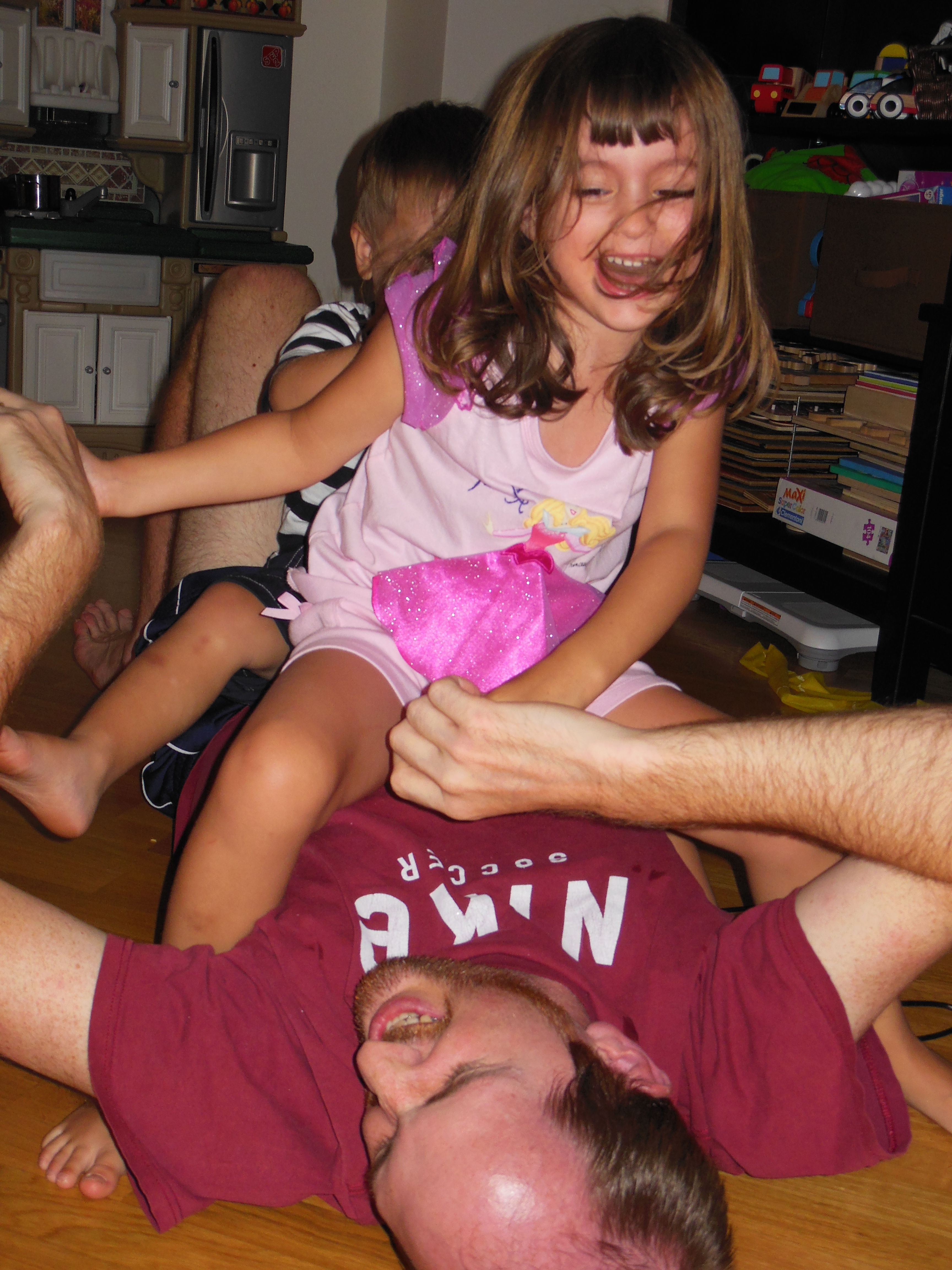
Her smile shines even through her hair.


Leave a comment

Nightmares and Love

About one month ago I started having nightmares. They were all about my children, and they were all horrible. I would wake up in a cold sweat, gripping the covers with terror-convulsed fingers and sometimes struggling to catch my breath because of the weight of fear and anguish compressing my chest. I woke from many of the nightmares with no clear memory of the specific content of the dream, but with only the shattering emotional effects echoing through my body and the sense of dread for my children. The two most horrible dreams, however, have left a lasting impression.  I suspect that if I were to close my eyes now and allow myself to return to their dreadful phantasms, I would quickly be drawn back down into their disorienting, terrifying vortex. Even with open eyes and alert mind I can still feel the panic, the torture, of watching my children suffer horrific experiences from which I could not protect them.

I will not share the specific nature of the dreams — they do not deserve to be recreated in any form — but they do have one salient feature. The major part of each dream preceded the actual catastrophic event. Rather, they played out, in excruciating detail, the preceding minutes. Minutes in which I was aware of the extreme danger threatening my children, and minutes in which I strove with every ounce of strength, and bravery, and will that I possessed to prevent the inevitable conclusion. There was absolutely no thought in my mind, no motion in my body, and no word issuing from my lips that was not completely devoted to my efforts to save my children. Even though these experiences were “merely” dreams, they produced in me a feeling of total desperation that has forever transformed my understanding of that emotion.

As I said, these nightmares began about one month ago. I am sure that a psychoanalyst would find much fruitful soil in that timing, coinciding as it did with my youngest child’s exit from my immediate sphere of control and protection to enter pre-school. I, however, find much more weighty import in the timing of their conclusion. The last nightmare was in the early hours of last Saturday morning, about one week ago. It was so intense that my shaking actually woke my husband and left me in a state of such tightly wound anxiety that I could not relax back into sleep for more than 90 minutes. It stayed with me throughout the weekend, casting a dim shadow over all our normal, prosaic activities and causing me to frequently reach out, involuntarily, to touch or stroke my children’s’ little faces. Reassuring myself that they were well and happy.

On Sunday night our church had a special service run by the young adults’ group. Other than a short homily from the pastor and a poignant skit the night was devoted to worship through song. It was a wonderful time of joining together and the joy of worship completely washed the nightmares out of my mind. Then, toward the end of the service, we sang a song that included the lyrics “you gave your Son.” I cannot remember what the song was, or any of the other words because that one simple phrase sent a lightening bolt through my mind. I was instantaneously transported back into the terrorized center of my nightmares and heard a voice as clear and distinct as a trumpet call say to me “that is what I went through for you.”

“For God so loved the world that he gave his only begotten son…” (John 3:16). It is the most famous bible verse in the world, and it is so familiar to most of us (even those who do not believe it) that it has lost all meaning.  But in the echo of my nightmares I could not possibly dismiss with casual familiarity the statement that God gave his son. For the better part of a month I had been experiencing, in frighteningly real imagination, the desperation of a parent fighting to protect her children. The horror of the nightmares was most intense not only because of the horrible things happening to my children, but because they centered upon the soul-wrenching pain of seeing what is happening to them and being unable to prevent it despite struggling with every fiber of my being. I cannot imagine seeing my children in danger of any kind and not immediately jumping to save them, much less the combined horror of mortal and spiritual danger.

And yet, that is precisely the claim of the Bible. God the Creator (the parent-person of the Trinity) allowed Jesus (the Son who came from the very essence of God’s self) to suffer one of the most horrific deaths that human beings have ever devised to punish each other. What is more, the accounts of Jesus’ words on the cross make it clear that the physical pain of this experience was in no way the worst part of his ordeal. In taking  all human sin onto himself in order to break its power, Jesus was utterly separated from God the Father – the most shattering cosmic separation that could ever take place. “My God, My God, why have you forsaken me?”

As a parent, I cannot imagine the pain of hearing that accusation from my child — it would be hard enough to see my child suffering something unimaginable and to fail to stop it. To also be accused of abandonment by that child would be unbearable. In my rational mind I can argue that Jesus was not the helpless child that I see in the faces of my two precious little ones. He prayed to his Father to provide another way for him to accomplish his purpose on earth, but he ended that prayer with an acceptance God’s will — willing submission to the path of self-sacrifice. On an intellectual level this intentional participation makes all the difference. However, in my emotional imagination, the source of those horrid nightmares, I have never really been able to understand. The accusation that God is the divine child abuser has always been uncomfortably close. How could God be so cold?

But the voice that spoke in my mind last Sunday night was anything but cold. It throbbed with an intensity of emotion that exceeds my own capacity for feeling as much as the length of my sight is exceeded by the breadth of the universe. Suddenly I understood something that has somehow eluded me for more than 30 years of Christian life. Jesus is not the only one who suffered the pain of the cross. The Father-heart of God suffered far more desperately than I ever could, even if my nightmares were to come true. It was a level of pain that my experiences as a parent only allow me to glimpse dimly. The shuddering depth and power of that agony staggered me then, and a week later I am still overpowered by it.

And yet God the Father and God the Son willingly endured that horrible day of death, and the even more horrible three days of separation that followed. They voluntarily entered into an experience far worse than the nightmare scenarios that I fought against with everything I had in me. It is unbelievable, but I cannot do anything but believe. And I stand in awe.

I’m sure that there are some people reading this who do not believe in the spiritual significance of the strange death of a Jewish prophet nearly two thousand years ago. If that is you (and if you have kept reading this far) it is not for me to convince you otherwise. All I can do it to witness to the power of my own experience. For all of us, however, believing or not, I think that the claim of such a love bears consideration. Because love really is what that whole story is about. For God so loved the world… that both God the Father, and God the Son put themselves through an ordeal that we can barely touch on in our worst nightmares. All to save human beings from the even worse nightmare of total and eternal separation from God, and to instead give us the chance to become part of their family.

My sleep in the past week has been nightmare-free. I am grateful for that. And I am grateful for my family – my happy, healthy children and the amazing husband who shares with me the joys and challenges of raising and protecting them.

Beyond this gratitude, however, I am overwhelmed again by gratitude for that unimaginable sacrifice nearly two thousand years ago. I know that even in my very best moments of maternal devotion I am not capable of that kind of love. I am not capable of it, but I am so, eternally grateful for it.